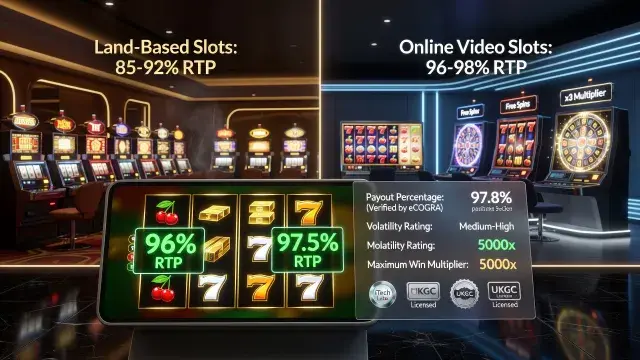

A slot machine returning 96% to players over its lifetime will still take your money on any given session - and that's the part most gamblers never quite grasp. RTP is a long-run mathematical average, not a promise, and confusing the two leads to disappointment and bad bankroll decisions. Yet understanding this single number, and what sits behind it, separates players who make informed choices from those who gamble blind.
Payout percentage isn't marketing fluff. It's a calculated figure derived from millions of simulated spins, audited by independent testing labs, and published (sometimes buried) in game information screens. Players who take five minutes to check this figure before depositing put themselves in a measurably better position than those who don't. For anyone hunting for a strong example of what a well-built, transparent game looks like, this page offers a detailed look at one such title, showing exactly how these mechanics play out in practice. The rest of this piece breaks down what RTP actually measures, how it differs from volatility, and which games consistently rank among the best RTP games available at a real money casino today.
What RTP Really Means and Why It Matters
Return to Player is expressed as a percentage representing the theoretical amount a slot pays back to players over an extended number of spins - often modeled at millions of rounds during testing. A game with 97% RTP is mathematically designed to return 97 cents of every dollar wagered, averaged across its entire lifecycle. The remaining 3% represents the house edge, the casino's built-in margin.
The Mathematics Behind the Percentage
RTP is calculated by game developers using simulation software that runs a slot through an enormous number of virtual spins, tracking every win and loss. This isn't guesswork or a marketing estimate - it's a fixed value baked into the game's code before it ever reaches a casino floor or a digital lobby. Regulators and independent testing agencies verify these figures before certifying a title for public release.
RTP vs. Actual Session Results
Here's where confusion creeps in. A 96% RTP slot can still produce a losing streak lasting hundreds of spins, or a jackpot hit within the first ten. Short-term results are governed by variance, not by the theoretical average. RTP only becomes meaningful across a large sample size - which is precisely why it should inform game selection, not session-by-session expectations.
Why Casinos Publish These Figures
Licensed operators disclose RTP because regulators require transparency, and because informed players tend to trust operators who don't hide the math. A real money casino operating under a reputable license will typically list RTP figures directly on the game or in a linked information panel.
Understanding Online Slots RTP vs. Land-Based Machines
Digital slots consistently outperform their physical counterparts in payout percentage, and the reasons come down to overhead and competition rather than any inherent generosity from operators.
Lower Overhead, Higher Payback
A physical casino carries costs a digital platform doesn't: real estate, staffing, machine maintenance, utilities. Online slots RTP figures tend to sit several percentage points higher than land-based equivalents because operators can afford tighter margins when overhead is minimal.
Regulatory Transparency Requirements
Many jurisdictions mandate that online slot RTP be published and independently audited, whereas physical machines in some regions face looser disclosure rules. This regulatory gap is one reason players increasingly prefer digital platforms when payout percentage is a priority.
Software Providers and Consistency
Reputable game studios build RTP directly into their software and rarely alter it post-launch without new certification. This consistency lets players research a title once and trust the figure holds across every licensed platform offering that game.
- Online slots typically range between 94% and 98% RTP
- Land-based machines often average 85% to 92%
- Progressive jackpot slots usually sit at the lower end due to jackpot contributions
Payout Percentage: The Number Every Player Should Check
Payout percentage and RTP are effectively the same concept described from two angles - one theoretical, one observed. Casinos sometimes report actual payout percentage over a fixed period, which can diverge slightly from theoretical RTP due to real-world variance across thousands of live sessions.
Where to Find This Information
Most licensed slots display RTP inside the paytable or information menu, accessible through a small "i" icon on the game screen. Third-party auditing bodies also publish payout reports for licensed operators, giving players an external checkpoint beyond what the casino itself discloses.
Why Some Games Hide or Bury the Figure
Not every operator makes this information easy to find. Some games, particularly those with multiple RTP variants selectable by the operator, display a range rather than a fixed number. Players should treat vague or absent RTP disclosure as a signal to look elsewhere.
How Payout Percentage Affects Long-Term Value
A one or two percentage point difference sounds trivial but compounds significantly across thousands of spins. Choosing a 98% RTP title over a 94% one effectively doubles the house edge you're playing against - a meaningful distinction for anyone playing regularly rather than occasionally.
How to Identify High RTP Slots Before You Play
Finding high RTP slots requires more than trusting a game's reputation or visual appeal. A methodical approach saves money and frustration.
Checking the Information Panel
Before wagering real money, open the paytable or rules screen. Reputable developers list RTP clearly, often alongside volatility ratings and maximum win multipliers. If this information is absent, that's a red flag worth taking seriously.
Using Independent Comparison Resources
Several third-party sites track RTP across hundreds of titles and developers, updating figures as games receive certification or revision. Cross-referencing a casino's listed RTP against these independent databases confirms accuracy and catches discrepancies.
Recognizing Variable RTP Settings
Some game engines allow operators to select from a range of certified RTP settings for the same title. This means the identical slot might return 96% at one real money casino and 94% at another. Always verify the specific RTP displayed on the platform you're actually using, not a generic figure quoted elsewhere.
The Best RTP Games Across Popular Categories
Certain game types and mechanics tend to correlate with stronger payout percentages, though individual titles still vary considerably within each category.
Classic Three-Reel Slots
Simpler mechanics often mean simpler math, and many classic-style slots post RTPs above 96% due to reduced feature overhead. Fewer bonus rounds and special symbols translate into more straightforward, often more generous, payback structures.
Video Slots with Bonus Features
Feature-rich video slots vary widely, but the best RTP games in this category balance entertainment value with strong payback, frequently landing between 96% and 97.5%. Free spins, multipliers, and cascading reels don't inherently hurt RTP - it depends entirely on how the developer structures the math model.
Progressive Jackpot Slots
These titles allocate a portion of every wager toward a growing jackpot, which typically lowers base RTP compared to non-progressive equivalents. Players chasing high RTP slots specifically should generally look outside progressive jackpot titles unless the jackpot potential outweighs the payback tradeoff for their personal preference.
Table Game Adaptations
Digital blackjack, baccarat, and certain video poker variants often post RTPs exceeding 98%, outperforming most slot categories entirely. Players prioritizing payout percentage above all else frequently find better value here than in traditional slot titles.
Choosing a Real Money Casino That Supports High RTP Play
Game selection matters, but the platform hosting those games matters just as much. A high RTP slot means little if the operator behind it lacks proper licensing or fair payout practices.
Verifying Licensing and Auditing Standards
Look for licenses from recognized regulatory bodies and confirmation that games undergo independent testing. Operators that partner with certified game labs tend to offer more reliable, consistently audited RTP figures across their entire library.
Comparing Game Libraries by Provider
Different software providers maintain different average RTPs across their catalogs. Researching which developers a real money casino partners with gives a reasonable preview of the payout landscape before you even open a single game.
Reading Terms Around Bonuses and Wagering
A generous welcome bonus tied to unreasonable wagering requirements can erode the value of even the highest RTP slots. Always check whether bonus terms restrict play to specific games, and whether those games carry favorable payout percentages.
Frequently Asked Questions
Does a higher RTP guarantee more frequent wins?
No. RTP measures long-term payback across millions of spins, not the frequency of individual wins. A high RTP slot can still have long dry stretches, while a lower RTP game with high hit frequency might pay out small amounts more often.
Is RTP the same as volatility?
No, they measure different things entirely. RTP reflects theoretical long-term payback, while volatility describes how wins are distributed - low volatility games pay smaller amounts more consistently, high volatility games pay rarely but with larger potential wins.
Can a casino change a slot's RTP after launch?
Generally, no, not without recertifying the game through regulatory testing. Some game engines support multiple certified RTP settings that operators can select from, but switching requires proper licensing approval, not a simple backend adjustment.
Why do RTP figures sometimes differ between casinos for the same game?
Certain game providers build multiple certified RTP variants into a single title, letting operators choose which version to offer. Always check the specific RTP listed on the platform you're using rather than assuming it matches figures found elsewhere.
Are high RTP slots better for beginners?
Generally yes, since they lose money more slowly on average, giving new players more playtime and a gentler introduction to bankroll management. Pairing high RTP with lower volatility tends to produce the smoothest experience for someone still learning how slots behave.
Where can I verify a game's RTP is accurate?
Check the in-game information panel first, then cross-reference against independent RTP tracking databases and the testing lab certifications listed on the casino's licensing page. Discrepancies between these sources are worth investigating before wagering real money.