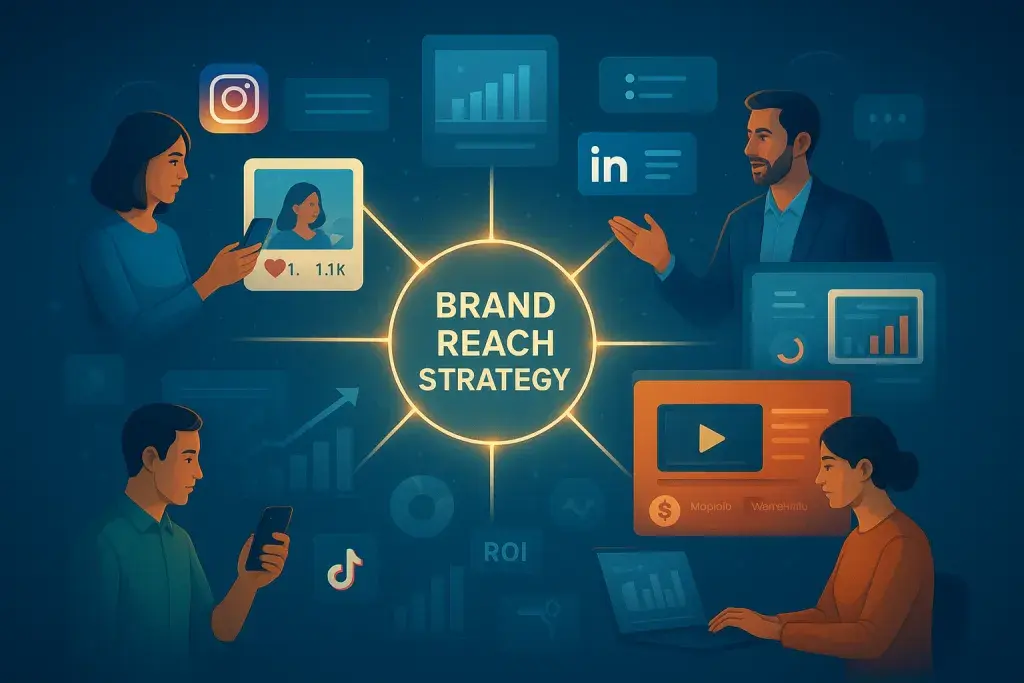
Most brands are not suffering from a lack of content - they are suffering from a lack of connection between their content efforts. A business can post daily on Instagram, run paid ads on multiple platforms, and upload videos to YouTube every week, yet still find that none of these activities seem to reinforce each other. The audience on one channel has no idea the brand exists on another. The advertising budget amplifies content that never performed organically. The YouTube channel sits in isolation, disconnected from the social media strategy entirely. This fragmentation is the silent killer of brand growth, and it is far more common than most marketing teams are willing to admit.
The brands that consistently expand their reach are not necessarily the ones with the largest budgets. They are the ones that have figured out how to make each channel do more by connecting it deliberately to every other channel. Social media marketing builds community. Digital advertising strategies accelerate reach beyond existing audiences. Online video content creates lasting visibility. Influencer partnerships introduce brands to audiences that paid ads simply cannot replicate. When these disciplines are designed to work together rather than independently, the effect compounds. If you have been exploring ways to build a stronger video presence, resources like the accs market youtube channel offer a useful window into how channel growth and monetization intersect in practice - a reminder that platform strategy and revenue thinking must develop in parallel.
This article presents a structured framework for integrating all of these disciplines into a coherent brand reach strategy. Whether you are a brand manager, a content creator, or a digital marketer responsible for growth, what follows is designed to be actionable, specific, and honest about what actually works across each channel and why.
Understanding the Modern Brand Reach Ecosystem
Brand reach is not a single number or a single channel outcome. It is the cumulative product of how many people encounter your brand, in how many contexts, and with what level of relevance. The shift from broadcast marketing to multi-platform ecosystems has fundamentally changed what effective reach looks like - and many brands are still measuring and managing it with frameworks that belong to a previous decade.
Understanding the ecosystem means recognizing that no platform operates in isolation. A viewer might discover a brand through a short-form video on one platform, look it up on another, watch a longer YouTube video before deciding to trust it, and then convert after seeing a retargeted ad. Each of those touchpoints belongs to a different channel, but each one contributed to the outcome. Brands that treat their channels as separate silos miss the cumulative effect that only integrated thinking can produce.
Why a Multi-Channel Strategy Is No Longer Optional
The average consumer interacts with a brand multiple times across multiple platforms before making a purchasing decision. This is not a trend - it reflects how information consumption actually works in a media environment where attention moves fluidly between formats, devices, and platforms throughout the day. A brand that is present on only one or two of those touchpoints is, by definition, invisible at every other moment when a buying decision is being considered.
Platform algorithm changes have made this reality even more pressing. When any single platform reduces organic reach - which every major social platform has done repeatedly over the past several years - brands that have concentrated all their efforts there experience sudden, sharp drops in visibility. Diversification is not just a growth strategy; it is a stability strategy. The brands that weathered algorithm shifts most effectively were the ones that had already built meaningful presence across several channels, so a drop on one platform was offset by strength on others.
- Audience fragmentation means different demographic segments are concentrated on different platforms, and a single-channel brand misses large portions of its potential market
- Algorithm dependency on a single platform creates existential risk when ranking or distribution rules change
- Multi-channel presence creates a compounding awareness effect - each new touchpoint increases the probability of recognition and trust
- Brands with cross-channel consistency are perceived as more established and credible by audiences who encounter them in multiple contexts
- Integrated channel strategies allow performance data from one channel to inform and improve decisions on others
Key Definitions: Social Media Marketing, Digital Advertising, and Online Video Content
These three disciplines are frequently grouped together or used interchangeably, but they operate through different mechanics, serve different purposes, and require different skill sets. Conflating them leads to misaligned expectations, misallocated budgets, and strategies that underperform because the wrong tool is being used for the job.
Social media marketing refers to the organic side of brand communication on platforms such as Instagram, LinkedIn, TikTok, X, and Facebook. Its primary currency is content quality, community engagement, and consistency over time. It builds brand equity gradually and creates a foundation of audience trust that paid channels can amplify but cannot manufacture on their own.
Digital advertising strategies encompass paid placements across search platforms, social networks, display networks, and programmatic systems. Unlike organic social, paid advertising can generate reach almost immediately - but it requires ongoing investment and stops the moment the budget runs out. It is most effective when it amplifies content and messaging that already demonstrates value organically.
Online video content is a format layer that operates across both organic and paid channels. YouTube is the dominant long-form video platform globally, but video as a format now appears across nearly every major platform in some form. The strategic importance of video is its ability to build trust quickly - a well-structured video communicates personality, expertise, and authenticity in ways that static content rarely achieves.
| Channel Type | Primary Function | Cost Model | Best Used For | Key Metric |
|---|---|---|---|---|
| Social Media Marketing | Community building, brand voice | Organic (time and content investment) | Long-term loyalty, engagement | Engagement rate, follower growth |
| Digital Advertising | Targeted reach, conversion | Paid (CPM, CPC, CPA models) | Rapid reach, retargeting, measurable ROI | Return on ad spend, click-through rate, cost per acquisition |
| Online Video Content | Education, storytelling, visibility | Production cost plus distribution | Search visibility, trust-building, long-term traffic | Watch time, views, audience retention |
| Influencer Marketing | Social proof, new audience access | Fee-based or performance commission | Credibility transfer, niche targeting | Reach, conversions, earned media value |
Building a Powerful Social Media Marketing Foundation
The foundation of any integrated brand strategy is organic social media presence - not because it is the cheapest channel, but because it is the most revealing one. How audiences respond to your organic content tells you what messaging resonates, what formats hold attention, and what topics your audience actually cares about. That information is invaluable when it comes time to design paid campaigns, brief influencer partners, or plan video content for YouTube.
Brands that treat social media marketing as an afterthought - posting irregularly, recycling generic content, and measuring success only by follower counts - are missing the diagnostic function that organic social serves. Every post is a small experiment. Accumulated over months, those experiments produce a reliable picture of audience preferences that no amount of paid media can replicate.
Choosing the Right Platforms for Your Audience
Platform selection is a strategic decision, not a default one. The instinct to be everywhere simultaneously dilutes effort and produces mediocre results across the board. The more disciplined approach is to identify the two or three platforms where your target audience is genuinely concentrated, invest fully in those, and expand only once you have mastered them.
Platform selection should be driven by audience demographics and content format compatibility. LinkedIn rewards long-form professional content and is unusually effective for B2B brands and thought leadership. Instagram's visual format suits brands in fashion, food, travel, beauty, and lifestyle. TikTok reaches younger audiences through short-form video and algorithmic discovery that gives new accounts a genuine chance at organic reach. YouTube rewards depth and consistency and is effective for brands whose audiences seek detailed information before making decisions.
- Audit your existing audience before choosing platforms - check where your current customers actually spend time online
- Match your content format strengths to platform expectations - a brand that produces great long-form video should prioritize YouTube over short-clip-dominated platforms
- Consider your team's capacity honestly - three platforms managed well will always outperform five platforms managed poorly
- Reassess platform investment annually, as audience concentration on platforms shifts over time
One practical warning: resist the pressure to join every new platform at launch. The cost of spreading resources across an unproven platform before its audience stabilizes is rarely worth the speculative upside. Establish dominance where your audience already exists before exploring where they might go next.
Content Strategy Pillars That Drive Consistent Reach
Consistent social media reach does not come from posting frequently - it comes from posting with purpose. Brands that publish content without a defined strategic framework produce an incoherent mix that confuses both audiences and algorithms. The solution is a content pillar structure: a set of three to five recurring themes that represent the intersection of your brand's expertise and your audience's genuine interests.
A software brand focused on productivity tools, for example, might build content pillars around workflow tips, product demonstrations, user stories, industry news, and team culture. Every piece of content then belongs to one of these pillars, which creates a recognizable rhythm for the audience and signals to platform algorithms that the account publishes consistently within a defined topic space - which generally improves distribution.
- Educational content that solves a problem or answers a question your audience is actively asking
- Community content that acknowledges, celebrates, or involves your existing audience directly
- Brand story content that communicates values, behind-the-scenes reality, and personality
- Product or service content that demonstrates value without reading as a hard sell
- Curated content that positions your brand as a trustworthy filter for industry news and relevant ideas
A practical ratio that works well for most brands is approximately 80% value-driven content to 20% promotional content. This is not a rigid rule, but it reflects the basic reality that audiences follow brands for value, not for advertising, and that earning trust through consistent value delivery makes promotional content far more effective when it does appear.
Using Analytics to Refine and Expand Organic Reach
Platform analytics are diagnostic tools, not just performance reports. The brands that grow their organic reach most efficiently are the ones that review analytics regularly - not to celebrate good numbers, but to understand why certain content performed and use that knowledge to make better decisions about what to produce next.
Engagement rate is more informative than raw reach because it measures the proportion of your audience that found a piece of content worth interacting with. A post that reaches 10,000 people and generates 500 interactions is more meaningful than one that reaches 50,000 and generates 200. Save and share rates are particularly valuable signals - when an audience member saves a post, they have judged it worth returning to, which is a stronger endorsement than a passive like.
| Metric | What It Measures | Why It Matters | Practical Benchmark |
|---|---|---|---|
| Engagement Rate | Interactions relative to reach or follower count | Indicates content resonance and relevance | 1-5% varies by platform and audience size |
| Reach Rate | Percentage of followers who saw the content | Measures algorithmic distribution efficiency | 10-20% is a reasonable organic target |
| Save and Share Rate | Content saved or forwarded by viewers | Signals high-value content that audiences want to reference or share | Higher rates indicate stronger authority signals |
| Follower Growth Rate | Net new followers over a defined period | Reflects brand momentum and content appeal | Consistent month-over-month growth is the target, not a single spike |
Designing Effective Digital Advertising Strategies for Brand Growth
Paid digital advertising is what turns a well-built organic presence into a scalable reach engine. But the relationship between organic and paid is directional: organic content should prove the message before paid media broadcasts it. Brands that skip this sequence - spending heavily on paid advertising without testing messaging organically first - tend to burn budget amplifying content that audiences were already ignoring for free.
Effective digital advertising strategies are built on three foundations: precise audience definition, disciplined creative testing, and systematic optimization based on real performance data. None of these is particularly glamorous, but all three are what separates campaigns that generate measurable returns from ones that generate impressions without impact.
The Core Components of a High-Performance Digital Ad Strategy
Building a paid advertising system that reliably grows brand reach requires more than selecting a budget and choosing an audience. It requires a deliberate architecture that covers every stage of the customer journey - from first awareness through consideration to conversion - with content designed specifically for where the audience is in that journey.
Awareness-stage advertising introduces the brand to people who have never encountered it. The creative at this stage should prioritize attention and relevance over immediate conversion. Consideration-stage advertising reaches audiences who have already shown some interest - through a website visit, a video view, or a profile interaction - and deepens their understanding of why the brand is worth their attention. Conversion-stage advertising targets audiences who are close to a decision and needs to provide a clear, compelling reason to act.
- Define campaign objectives that connect to specific business outcomes, not just platform metrics
- Build audience segments based on behavioral data, interests, and lookalike modeling rather than demographics alone
- Create platform-native ad creatives designed for each funnel stage - a retargeting ad should look and sound different from a brand awareness ad
- Run controlled A/B tests on one variable at a time - headline, visual, call to action, or audience - to generate clean learning
- Establish baseline performance benchmarks before scaling any campaign
- Monitor key metrics weekly and shift budget toward top-performing ad sets systematically
- Build retargeting sequences that re-engage warm audiences with progressively more specific messaging
Paid Social vs. Search vs. Display vs. Programmatic: Choosing the Right Mix
Each paid advertising format operates through fundamentally different targeting logic, and that difference determines when each format is most useful. Understanding the distinctions prevents the common mistake of using a brand awareness format when conversion is the goal, or vice versa.
Paid social advertising targets audiences based on who they are - their demographics, interests, behavioral patterns, and platform activity. It is most effective for reaching new audiences and building brand familiarity at the top of the funnel. Search advertising targets people based on what they are actively looking for at that moment. This intent-based targeting makes search advertising particularly effective at the conversion stage, because the audience is already demonstrating demand for what the brand offers. Display advertising places visual ads across third-party websites and apps, typically through behavioral or contextual targeting. It excels at retargeting - keeping a brand visible to audiences who have already shown interest. Programmatic advertising automates the buying process across large ad networks, using data to serve ads to defined audience segments in real time, and is most effective for brands with sufficient audience data and the volume needed to optimize efficiently.
| Ad Format | Targeting Method | Best Funnel Stage | Primary Strength | Main Limitation |
|---|---|---|---|---|
| Paid Social | Audience identity and interests | Awareness and consideration | Reaching new audiences at scale | Limited purchase intent signal |
| Search Ads | Active keyword intent | Conversion | High-intent audience capture | Higher cost per click in competitive categories |
| Display Ads | Behavioral and contextual | Retargeting and brand recall | Cost-effective ongoing visibility | Lower engagement rates than social formats |
| Programmatic | Data-driven behavioral targeting | All stages depending on setup | Scale and precision combined | Requires significant data volume to optimize |
Budget Allocation and ROI Optimization
Budget allocation is not a decision made once at campaign launch. It is an ongoing process of shifting resources toward what is demonstrably working and away from what is not. Brands that set a budget, launch campaigns, and then evaluate results only at the end of a campaign cycle consistently leave significant performance on the table.
A practical starting framework for brands building out their paid advertising for the first time is to allocate the majority of budget to proven formats and messaging - those that have already demonstrated traction organically or in previous campaigns - while reserving a portion for testing new formats, platforms, or audience segments. As testing yields results, winning combinations should be scaled while underperforming ones are paused rather than nursed.
- Return on ad spend is the core efficiency metric - calculate it per campaign, per ad set, and per creative to identify where value is being created
- Frequency capping prevents overexposure to the same audience, which causes engagement rates to drop and brand perception to suffer
- UTM parameters and conversion tracking must be configured correctly before any campaign launches - retroactive data recovery is rarely possible
- Scaling a campaign too quickly, before it has generated enough data to optimize against, typically leads to inflated costs and deteriorating performance
- Creative fatigue is real and predictable - plan for refreshed ad creative every four to six weeks for active campaigns
Harnessing Online Video Content and YouTube Monetization
Video has become the default format through which brands build trust at scale. The reason is structural: video communicates tone, expertise, and personality simultaneously in ways that text and static images cannot. A well-produced YouTube video that answers a real question in depth builds more brand credibility in twelve minutes than a month of social media posts can achieve. That is not an argument against social media - it is an argument for making video a central pillar of any serious brand content strategy.
YouTube occupies a unique position in the digital landscape. It functions simultaneously as a video platform, a content discovery engine, and a social community - and it rewards long-term consistency in ways that social platforms rarely do. A video published with strong optimization can continue attracting new viewers for years without any additional investment, which makes YouTube one of the most capital-efficient content investments a brand can make over the long term.
Why YouTube Is the Centerpiece of Online Video Strategy
YouTube's algorithmic structure rewards sustained viewer satisfaction above short-term traffic spikes. Watch time, audience retention, and click-through rates from thumbnails are the primary signals that determine how widely YouTube distributes a video. This means that quality and relevance matter more than production budget - a video that genuinely helps viewers and holds their attention will consistently outperform a polished video that fails to engage.
The platform's search-like discovery behavior also differentiates it from social platforms. When someone searches for how to solve a problem, compare products, or understand a concept, YouTube often surfaces relevant videos in those results. This means that a brand's YouTube library accumulates discoverability over time - each well-optimized video adds another entry point through which new audiences can find the brand organically.
- YouTube's dual role as a video platform and content discovery destination gives it unique long-term traffic value compared to social media platforms
- Watch time and retention rate are the platform's most influential quality signals - content that holds attention is content that gets distributed
- Evergreen videos - those that address questions relevant regardless of when they are watched - continue generating views and brand impressions months or years after publication
- YouTube's global audience breadth makes it viable for brands at virtually every scale, from solo creators to large enterprises
YouTube Monetization: Revenue Streams Explained
YouTube monetization is not a single mechanism that activates at a certain subscriber count. It is a layered system of revenue opportunities that expand as a channel's audience and engagement grow. Understanding each layer allows brands and creators to plan their content investment around multiple income streams rather than depending entirely on ad revenue, which fluctuates based on advertiser demand, content category, and viewing seasonality.
- YouTube Partner Program ad revenue: Activated once a channel meets the platform's eligibility thresholds, this is CPM-based income from ads served before and during videos. Revenue varies significantly by content category and audience geography.
- Channel Memberships: Subscribers pay a monthly fee in exchange for exclusive content, badges, or community perks, creating a recurring revenue stream that is relatively insulated from algorithm changes.
- Super Thanks and Super Chat: Viewer-initiated payments made during live streams and on published videos, rewarding content that generates strong community connection.
- YouTube Shopping integration: Product tagging within videos allows brands to connect content directly to purchasing, reducing the distance between discovery and conversion.
- Brand sponsorships: Direct commercial agreements between channel owners and advertisers for integrated mentions, dedicated segments, or full video sponsorships - often the highest-revenue stream for established channels.
- Affiliate marketing: Commission-based income earned when viewers purchase products through tracked links shared in video descriptions or on-screen.
- YouTube Premium revenue share: Channels receive a proportional share of the subscription fee paid by Premium members based on their watch time from that audience segment.
Optimizing Video Content for Maximum Reach and Revenue
The gap between a video that performs and one that does not is rarely about production quality. It is almost always about discoverability and viewer experience - specifically, whether the video gives people a reason to click and then a reason to keep watching once they do.
Titles should communicate clear value and include terms that your target audience would realistically search for, without becoming mechanical keyword lists. Thumbnails need to work at small sizes across a range of devices - the most effective thumbnails communicate the video's core idea or emotional hook in under a second. Descriptions should be treated as structural tools: include relevant terms early, add timestamps for long videos, and use the space to direct viewers toward related content on the channel.
- Front-load value in the first thirty seconds - if a viewer does not see clear relevance immediately, they leave and the platform records a low retention signal
- Playlists group related videos into sequential viewing experiences that increase total session watch time, which is a positive signal for the channel overall
- End screens and cards guide viewers to their next piece of content rather than letting them drift to another channel after a video ends
- Community Posts and polls build engagement between video uploads and signal to the platform that the channel has an active, invested audience
- Repurposing YouTube videos into short clips for Instagram Reels, TikTok, and YouTube Shorts extends the reach of each piece of content without requiring full reproductions from scratch
Leveraging Influencer Marketing Trends to Amplify Brand Reach
Influencer marketing has moved well past its early phase of celebrity endorsement deals and follower-count metrics. The discipline has matured into a performance-driven, relationship-centered channel with its own analytics infrastructure, contract norms, and strategic frameworks. Brands that are still approaching influencer partnerships the way they did five years ago - by paying someone with a large following to post a photo - are consistently underperforming relative to those who understand how the channel actually works now.
The core insight that separates effective influencer marketing from expensive social advertising is this: the value of an influencer is not their audience size - it is their audience's trust in them. When that trust is genuine and the influencer's content recommendation feels authentic, the conversion effect is qualitatively different from anything a brand advertisement achieves on its own.
The Shift from Mega-Influencers to Micro and Nano Creators
One of the most significant structural shifts in current influencer marketing trends is the movement away from mega-influencers toward micro and nano creators. This shift is driven by data, not sentiment. Micro-influencers - those with audiences typically between 10,000 and 100,000 followers - tend to generate considerably higher engagement rates than accounts with millions of followers, and their audiences demonstrate stronger purchase intent from recommendations because the parasocial relationship is more intimate.
Nano creators - those with smaller but tightly defined communities - operate at an even more intimate scale. Their recommendations carry credibility precisely because they are not perceived as professional advertisers. For niche products or local brands, a nano creator with a highly engaged, relevant audience often outperforms a mega-influencer with a broader but shallower follower base by a substantial margin.
| Influencer Tier | Typical Follower Range | General Engagement Rate | Cost Level | Best Application |
|---|---|---|---|---|
| Nano | 1,000 - 10,000 | High (often above 7%) | Very low | Hyper-local or niche community trust-building |
| Micro | 10,000 - 100,000 | Moderate to high (3-7%) | Low to medium | Niche authority, stronger conversion likelihood |
| Macro | 100,000 - 1,000,000 | Lower (1-3%) | Medium to high | Broad brand awareness campaigns |
| Mega or Celebrity | 1,000,000+ | Low (often below 1.5%) | Very high | Mass market exposure and prestige signaling |
Current Influencer Marketing Trends Shaping Strategy in 2024-2025
The influencer landscape is changing fast enough that strategies built on last year's assumptions frequently underperform. Several trends are currently reshaping how brands approach creator partnerships, and understanding them is essential for building an influencer program that stays effective over time.
- Long-term ambassador programs are replacing one-off sponsored posts at the strategic level. Audiences recognize the difference between a creator who genuinely uses a product and one hired for a single post, and long-term partnerships produce better results because the trust is allowed to develop over time
- Performance-based compensation models are becoming more common, tying a portion of creator payment to actual conversions rather than impression guarantees alone
- B2B influencer marketing is growing meaningfully on LinkedIn and YouTube, where industry practitioners with relevant expertise reach professional audiences who value peer recommendations over traditional advertising
- Short-form video dominance continues to reshape influencer content across every platform - brands that brief influencers with short-form native content in mind consistently see higher organic reach for sponsored posts
- Audience co-creation - where influencers involve their followers in brand decisions, product development, or campaign directions - generates significantly higher engagement and purchase intent than passive promotional content
- Authenticity over production value has become a consistent preference signal from audiences - polished, scripted sponsored content performs worse than candid, personal recommendations even when the production quality is lower
Building Effective Influencer Partnerships That Deliver Results
Finding the right creator is a research process, not a browsing exercise. Follower count is the least predictive measure of partnership value. Audience demographics, content quality, engagement authenticity, and the degree to which the creator's established content naturally connects to your brand category are all more relevant than how many followers they have accumulated.
Before approaching any influencer, review their last thirty pieces of content. Look at the comment quality - are comments substantive or generic? Are engagement rates consistent across posts, or do they spike suspiciously on certain content? Does the creator's audience match your target customer profile in terms of age, location, and interests? These questions answer the one that actually matters: will this creator's recommendation reach and persuade the people your brand needs to reach?
- Define the partnership objective clearly before searching for creators - awareness, conversion, content production, and community building require different creator profiles
- Use creator discovery platforms to filter candidates by niche, engagement metrics, and audience demographics, then verify candidates manually before outreach
- Check engagement authenticity by reviewing comment quality and consistency of performance across different post types
- Develop a clear creative brief that communicates brand guidelines, key messages, and any mandatory inclusions without scripting the creator's voice away
- Give creators meaningful creative freedom - the most effective sponsored content sounds like the creator's genuine recommendation, not a brand advertisement with the creator's name attached
- Track performance through unique promo codes, affiliate links, and UTM-tagged URLs that attribute results to specific partnerships
- Identify top performers and develop long-term relationships rather than starting the discovery process from scratch for every campaign
Integrating All Channels: Building a Unified Brand Reach Strategy
Each of the disciplines covered so far - social media marketing, digital advertising strategies, online video content, and influencer partnerships - has genuine standalone value. But the brands generating the greatest reach are not simply doing all of them simultaneously. They are doing them in coordination, with each channel designed to amplify and feed the others. That coordination does not happen by accident. It requires a deliberate integration architecture.
Integration means that the audience who sees a sponsored post from an influencer can then encounter a retargeting ad, find a longer YouTube video that addresses their questions in depth, and experience consistent messaging throughout. It means that the brand voice, visual identity, and core value proposition remain recognizable across every touchpoint. And it means that performance data from each channel informs decisions across all the others.
Creating a Cross-Channel Content Ecosystem
The most practical integration framework most brands can implement is a content ecosystem built around anchor content. The concept is simple: produce one substantial piece of content - a long-form YouTube video, a detailed written piece, or a podcast episode - and then atomize it into platform-native formats for every other channel. This approach multiplies reach without multiplying production workload, and it ensures that messaging remains consistent across channels because all derivative content originates from the same source.
- Produce one long-form anchor content piece that addresses a question or problem your audience genuinely cares about
- Extract the key insights from that anchor piece and develop them into standalone social media posts for each active platform
- Create short-form video clips from the anchor video for YouTube Shorts, Instagram Reels, and TikTok - each formatted natively for its destination platform
- Brief influencer partners on the campaign theme, allowing them to express it in their own authentic voice rather than replicating the brand's exact messaging
- Identify top-performing organic content and amplify it with paid advertising spend to reach audiences beyond your existing follower base
- Serve retargeting ads to audiences who engaged with the organic content or visited relevant pages, with messaging that progresses their understanding or addresses likely objections
- Review performance data across all channels at the end of each content cycle and use the findings to refine the next anchor content topic and format
Aligning Paid, Organic, and Influencer Efforts Around Campaign Themes
Fragmentation in campaign messaging is one of the most common and costly integration failures. When the paid advertising campaign promotes one angle of a product, the organic social media content is focused on something unrelated, and the influencer partners have been briefed with a third set of talking points, the cumulative effect on the audience is confusion rather than persuasion. The brand appears inconsistent, and inconsistency erodes the trust that makes marketing effective.
Integrated campaign execution starts with a central creative theme or message that is flexible enough to be expressed differently across different channels and creators, but consistent enough to be immediately recognizable as part of the same brand story. Think of it as a shared narrative with channel-specific dialects - the core message is the same, but how it is told adapts to what each platform and each creator does naturally.
- Develop a campaign brief that defines the central message, target audience, key proof points, and any mandatory inclusions before briefing any channel or creator
- A unified brand voice guide prevents tone inconsistencies between organic social content, ad copy, and influencer deliverables
- Coordinate influencer content release dates with paid campaign launch windows to create reinforcing waves of exposure rather than isolated moments
- YouTube video content created for organic reach can often be repurposed as paid advertising creative with minimal adaptation, maximizing the return on production investment
- Map the sequence of channel touchpoints against the stages of the customer journey so that messaging builds progressively rather than repeating the same awareness-stage communication at every point
Measuring Integrated Campaign Performance Across Channels
Measurement is where integrated strategies most often break down in practice. When a customer converts after multiple touchpoints across different channels, conventional last-click attribution assigns all credit to the final interaction and renders every preceding touchpoint invisible. This leads brands to systematically undervalue their awareness channels - including social media marketing and influencer content - and over-invest in bottom-funnel conversion formats, weakening the top of the funnel over time.
Moving toward multi-touch attribution models provides a more accurate picture of how each channel contributes to overall performance. No attribution model is perfect, but understanding the tradeoffs between available models allows brands to make more informed decisions about where their budget and effort are actually generating value.
| Attribution Model | How Credit Is Assigned | Best Application | Key Limitation |
|---|---|---|---|
| Last-Click | Full credit to the final touchpoint before conversion | Simple conversion tracking for direct response campaigns | Makes awareness channels appear worthless |
| First-Click | Full credit to the first touchpoint in the journey | Evaluating discovery channel effectiveness | Ignores the role of nurture and conversion channels |
| Linear | Equal credit distributed across all touchpoints | Getting a balanced multi-channel view | Does not reflect the relative importance of each touchpoint |
| Time Decay | More credit to touchpoints closer to the conversion | Short sales cycles where recent interactions are most relevant | Systematically undervalues early awareness efforts |
| Data-Driven | Algorithm distributes credit based on measured impact | High-volume brands with sufficient data for modeling | Requires large data sets to produce reliable results |
Common Mistakes That Limit Brand Reach - and How to Avoid Them
Strategic mistakes in brand reach are rarely dramatic. They accumulate quietly - a slightly inconsistent posting schedule here, a misaligned influencer brief there, an ad campaign that never gets properly tracked - until the compounding effect of small errors produces a gap between the effort being invested and the results being generated that nobody can quite explain.
Understanding where brands most consistently go wrong is as practically useful as understanding best practices. Most of the following mistakes are entirely preventable once they are named, and correcting even two or three of them can produce noticeable improvement in reach and efficiency without requiring additional budget.
- Inconsistent publishing frequency: Erratic posting schedules confuse both platform algorithms and audiences. Consistency signals reliability, and reliability builds the kind of audience habit that drives organic reach over time. A sustainable schedule published reliably outperforms an ambitious schedule published sporadically.
- Avoiding video content: Brands that remain exclusively in text and static image formats are forfeiting the most effective trust-building format available and ceding significant organic reach to competitors who have committed to online video content.
- Selecting influencers by follower count alone: Reach without relevance generates impressions but not results. A smaller creator with a highly engaged audience in your exact product category will almost always outperform a larger creator whose audience only partially matches your target market.
- Using paid advertising to fix bad content: Paid digital advertising amplifies what works - it does not fix what doesn't. Spending money to distribute content that audiences were already ignoring organically produces expensive, low-performing campaigns.
- Launching campaigns without tracking infrastructure: Without properly configured conversion tracking, UTM parameters, and attribution tools in place before a campaign launches, optimization becomes guesswork and true ROI is unknowable.
- Ignoring platform algorithm updates: Every major platform adjusts its distribution logic regularly. Brands that do not monitor these changes and adapt their content strategy accordingly experience declining reach without understanding why it is happening.
- Treating social media as a broadcast channel: Brands that only publish and never engage - who post content but ignore comments, questions, and direct messages - consistently see lower organic reach and slower community growth than those who treat social media as a two-way conversation.
- Failing to repurpose content systematically: Producing entirely original content for every platform at every publishing interval is an unsustainable use of resources. A structured repurposing system multiplies the reach of each content investment without a proportional increase in production cost.
Questions and Answers
How do I know if my organic social content is ready to be amplified with paid advertising?
Look at engagement rate and save or share metrics before committing paid budget to any piece of organic content. If a post is generating above-average engagement relative to your channel's baseline - particularly if it is being saved or shared at a meaningful rate - that is a reliable signal that the content resonates with your existing audience and is worth testing with a paid distribution to cold audiences. Boosting content that performed poorly organically rarely changes the outcome.
What is the minimum realistic investment to start building a YouTube presence for a brand?
The minimum is primarily a time investment rather than a financial one. A camera, basic lighting, and free editing software are sufficient for early-stage YouTube content, and production quality matters far less than topic relevance and video structure. The more meaningful investment is the consistency required - a channel that publishes one well