
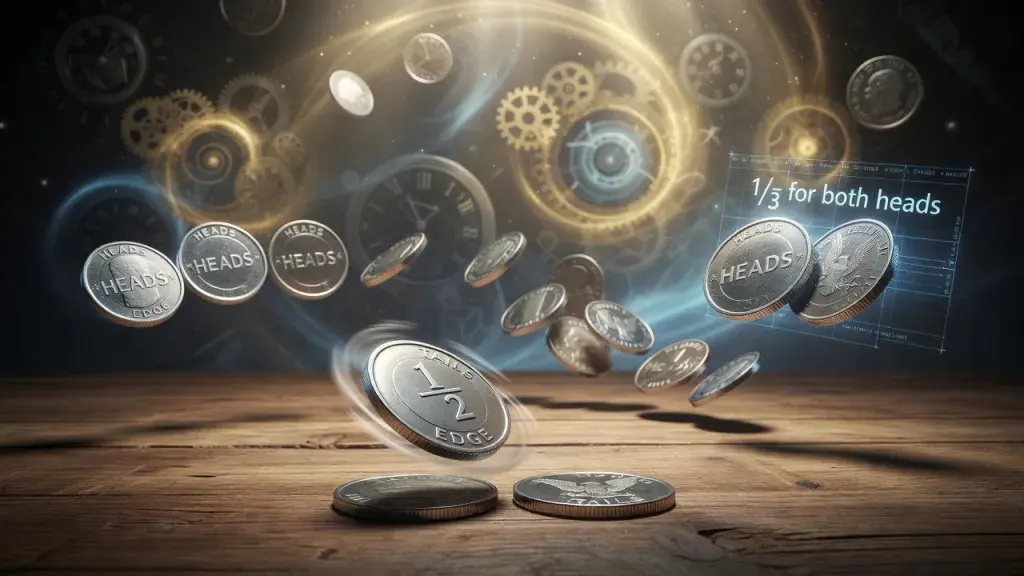
A coin flip lands on its edge roughly once in ten thousand throws, according to physics research on the mechanics of tossed coins. That single fact should make anyone question the assumption that a coin toss produces only two possible outcomes. Most people treat heads or tails as the definition of fairness itself - a fifty-fifty split, clean and beyond argument. Yet the moment you introduce spin variations, surface textures, or multi-coin sequences, that clean split starts to wobble.
This is where things get interesting for anyone who enjoys puzzles, games, or simple mental exercises rooted in probability. Unusual coin toss rules take a mechanism everyone thinks they understand and turn it into a source of genuine surprise. Some variations rely on physical trickery, like biased coins or altered flipping techniques. Others are purely mathematical, built to expose flaws in how people intuitively judge chance. If you want to see a modern, stylized take on this idea in action, this page offers a playful example of how flip-based mechanics get reimagined for entertainment rather than pure statistics.
What follows is a practical look at how these unconventional rules work, why they produce results that feel wrong even when they are mathematically sound, and how you can use them to sharpen your own understanding of probability. Along the way, we will cover games built around flipping challenges, the physics behind unpredictable landings, and puzzles that have stumped otherwise sharp thinkers.
Why Standard Coin Tosses Are Not as Random as You Think
The image of a coin toss as a perfectly random event is more folklore than fact. Physical studies on coin flipping - most notably work done by researchers at Stanford in the early 2000s - found that a coin is slightly more likely to land on the same face it started on, due to the mechanics of rotation and catching. That bias is small, often less than one percent, but it proves that a "fair" coin toss is really a fair-ish coin toss shaped by physics, not pure chance.
The Physics Behind a "Fair" Flip
When a coin is tossed, it rotates around its diameter, not in a perfect circular spin. The number of rotations before landing, the height of the toss, and how the coin is caught all influence the result. A coin caught in the hand rather than allowed to bounce on a surface tends to retain more of its starting-face bias. This is one reason casinos and formal sports settings insist on strict tossing procedures - consistency reduces the room for manipulation.
Human Bias in Flipping Technique
People who flip coins for a living, such as referees or dealers, often develop unconscious habits in grip, force, and wrist motion. Over thousands of repetitions, these habits can introduce a measurable skew. This human element is precisely why so many random coin flip game designs now rely on digital simulations rather than physical coins - removing the hand from the equation removes one more source of predictability.
Why This Matters for Game Design
Understanding the imperfections of a physical flip is the starting point for anyone designing or enjoying games with unusual coin toss rules. If a "simple" coin flip already carries hidden bias, then deliberately engineered variations can amplify that unpredictability into something genuinely engaging, rather than misleading.
Random Coin Flip Game Variations Worth Knowing
Once you accept that a coin toss is not mathematically pure, it becomes far more interesting to explore variations that intentionally bend the rules. These games exist across cultures, playgrounds, and now digital platforms, each adding a twist that changes the odds or the experience.
Multi-Coin Sequential Flips
Instead of flipping once, players flip a coin multiple times and must predict an exact sequence, such as three heads in a row. The probability drops sharply with each additional flip - a single flip is 50%, but three consecutive identical results fall to 12.5%. This format turns a simple choice into a compounding probability puzzle.
Weighted and Trick Coins
Some novelty games use coins deliberately weighted on one side, or two-headed coins used for demonstration purposes in probability classes. These are not meant for cheating in serious contexts - they are teaching tools that show how a visually identical object can carry a completely different outcome distribution.
Digital Randomization Layers
Modern random coin flip game formats, especially those built for entertainment platforms, often add layers such as speed variation, visual spin effects, or bonus multipliers tied to streaks. These layers do not necessarily change the core 50/50 math, but they change player perception of risk and reward, which is a psychological variable as powerful as the statistical one.
- Best-of-five flip tournaments with escalating stakes
- Reverse-call formats where you win by predicting incorrectly
- Timed flips where hesitation forfeits the round
- Team-based flips requiring unanimous predictions
Coin Flipping Challenges That Test Skill and Chance
Not every coin flip is about pure chance. Some formats introduce a skill component, turning flipping challenges into a hybrid of physical control and probability awareness.
Precision Flipping for Height and Rotation Count
Competitive flippers sometimes challenge each other to produce an exact number of rotations, judged by slow-motion review or counting by ear based on the coin's spin sound. This shifts the challenge from predicting an outcome to controlling the mechanics that produce it - a very different skill set entirely.
Catch-Free Landing Challenges
Instead of catching the coin, players let it fall and settle naturally, sometimes onto varied surfaces like carpet, wood, or sand. Each surface changes the bounce behavior and therefore the practical odds of heads versus tails versus an edge landing. This format highlights how much environment matters in outcomes that people assume are governed purely by the coin itself.
Group Elimination Flips
In elimination-style challenges, groups of participants flip simultaneously, and those matching the "wrong" result are removed each round. This format compounds individual randomness into a larger unpredictable outcome, since group size and matching patterns influence how quickly the pool narrows.
Unpredictable Coin Toss Outcomes and the Psychology Behind Them
People are notoriously bad at intuitively judging randomness, and coin tosses expose this weakness better than almost any other simple exercise.
The Gambler's Fallacy in Action
After several consecutive heads, many people instinctively believe tails is "due." This is the gambler's fallacy - the false belief that independent events influence each other. A fair coin has no memory. Each flip carries the same 50% probability regardless of prior results, yet the psychological pull toward believing otherwise is strong enough to affect real betting behavior.
Streak Illusions and Pattern-Seeking
Humans are pattern-seeking by nature, which means short streaks of heads or tails feel meaningful even when they are statistically unremarkable. A run of five identical results in twenty flips is not unusual; it is expected under normal probability distribution. Recognizing this helps explain why unpredictable coin toss outcomes feel more shocking than they actually are.
Why Unpredictability Feels More Dramatic Than It Is
Rare events, like edge landings or long streaks, get remembered and retold precisely because they are rare. This creates a skewed perception where people overestimate how often "weird" outcomes occur, reinforcing myths about coins being "hot" or "cold" - language borrowed inaccurately from independent probability into a false narrative of momentum.
Coin Flip Probability Puzzles for Sharper Thinking
Beyond games and challenges, coin flips serve as one of the cleanest tools for teaching and testing probability reasoning, precisely because the setup is so simple yet the implications run deep.
The Classic "Streak Prediction" Puzzle
Ask someone to predict how many flips it takes, on average, to see three heads in a row. Most underestimate significantly. The real answer, based on expected value calculations, is fourteen flips - far more than intuition suggests, and a strong demonstration of how compounding probability defies casual guessing.
The Two-Coin Paradox
If you flip two coins and at least one shows heads, what is the probability both are heads? Intuition says one-half, but the correct answer, once you account for all possible outcome combinations, is one-third. This puzzle regularly trips up even mathematically confident people, making it a favorite in probability courses.
Using Puzzles to Build Better Intuition
Working through these puzzles repeatedly retrains the brain to think in terms of full outcome spaces rather than gut feeling. This skill transfers directly to better decision-making in situations involving genuine uncertainty, from finance to everyday risk assessment.
- Calculate expected flips needed for a specific sequence
- Compare theoretical probability against real recorded results
- Test conditional probability scenarios with multiple coins
- Track long-run frequency to observe the law of large numbers firsthand
How to Design Your Own Unusual Coin Toss Rules
Creating a custom flipping game is an effective way to apply everything covered so far, turning abstract probability concepts into something tangible and fun for a group.
Setting Clear but Surprising Win Conditions
A good custom rule set introduces one twist without overcomplicating the core mechanic. Reversing the win condition, requiring a specific sequence, or adding a penalty for predictable guesses are all effective, low-complexity ways to inject unpredictability.
Balancing Fairness With Fun
Unusual does not mean unfair. The best custom games maintain a transparent probability structure even while surprising participants with the format. Players should be able to calculate their odds if they choose to, even if the experience feels chaotic in the moment.
Testing Your Rules Before Committing
Run a small batch of practice flips before introducing stakes. This reveals whether your rule set behaves as expected or whether hidden biases, similar to the physical ones discussed earlier, are skewing results in ways you did not anticipate.
Frequently Asked Questions
Is a coin toss really 50/50, or is that a myth?
A coin toss is close to 50/50 but not perfectly so. Physical studies show a slight bias toward the starting face due to rotation mechanics, typically under one percent, meaning the myth of perfect fairness is only approximately true rather than exact.
What is the most common mistake people make when predicting coin flip streaks?
The most common mistake is assuming past results influence future flips, known as the gambler's fallacy. Each flip is statistically independent, so a streak of heads has no bearing on the probability of the next flip.
Can weighted or trick coins actually be detected during a game?
Yes, weighted coins can often be detected through repeated testing, since their outcome distribution will deviate noticeably from 50/50 over a large enough sample of flips. Physical inspection, such as checking weight and edge symmetry, can also reveal tampering.
Why do coin flip probability puzzles feel harder than they should be?
These puzzles feel harder because human intuition evaluates probability based on partial information or gut feeling, while correct answers require accounting for every possible outcome combination. This mismatch between intuitive and mathematical reasoning is exactly why such puzzles are effective teaching tools.
Are digital coin flip simulators more reliable than physical coins?
Digital simulators are generally more reliable for pure randomness because they eliminate mechanical bias introduced by grip, spin, and catching technique. However, their fairness depends entirely on the quality of the random number generator behind them.
How many flips are needed to see a fair reflection of true probability?
A small number of flips, such as ten or twenty, can easily show skewed results purely by chance. Reliable reflection of true 50/50 probability typically requires several hundred flips, based on the law of large numbers.